


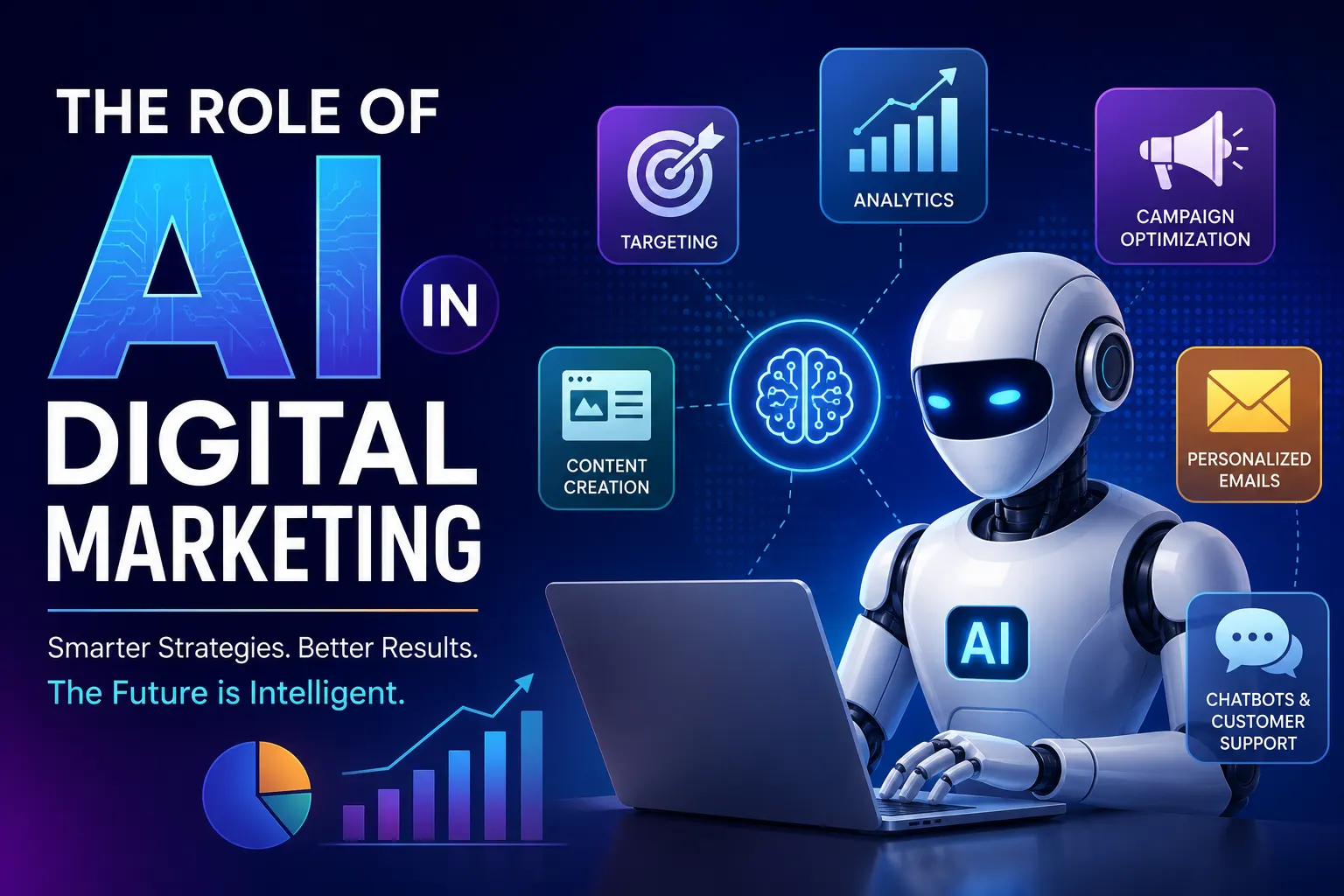
Artificial intelligence has transformed the way businesses connect with customers, analyze data, and optimize campaigns. Today, AI in Digital Marketing is no longer a futuristic concept—it’s a practical tool that helps businesses deliver personalized experiences, automate repetitive tasks, and make smarter marketing decisions. Whether you’re a small business owner or a marketing professional, understanding how AI works can help you stay competitive in an increasingly digital world. In this guide, we’ll explore the role of AI, its applications, benefits, challenges, and future impact on digital marketing.
Why AI in Digital Marketing Is Transforming Modern Marketing
Consumer expectations have evolved dramatically. Customers now expect personalized recommendations, fast responses, and relevant content across every digital platform. Meeting these expectations manually is nearly impossible, especially as businesses scale.
Artificial intelligence bridges this gap by analyzing large volumes of customer data, identifying patterns, and making predictions that improve marketing performance. From chatbots and predictive analytics to content optimization and marketing automation, AI has become a valuable partner for marketers seeking efficiency and better results.
Rather than replacing marketers, AI enhances their ability to make informed decisions and create meaningful customer experiences.
How AI in Digital Marketing Works
Artificial intelligence uses technologies such as machine learning, natural language processing (NLP), computer vision, and predictive analytics to process data and automate decision-making.
These technologies help marketers:
- Analyze customer behavior and preferences.
- Personalize content and product recommendations.
- Automate repetitive marketing tasks.
- Predict future buying behavior.
- Improve advertising performance.
- Enhance customer service with AI-powered chatbots.
- Optimize email campaigns and website experiences.
Instead of relying solely on assumptions, marketers use AI-generated insights to make data-driven decisions that improve campaign effectiveness.
Key Applications of Artificial Intelligence in Marketing
AI supports nearly every aspect of digital marketing. Below are some of its most impactful applications.
1. Personalized Customer Experiences
Personalization has become one of the biggest competitive advantages in online marketing.
AI analyzes browsing history, purchase behavior, demographics, and user interactions to recommend relevant products, articles, or services.
This creates a more engaging customer experience while increasing conversion rates and customer satisfaction.
2. Smarter Content Creation
AI-powered writing assistants help marketers generate content ideas, optimize headlines, improve readability, and identify relevant keywords.
While AI can accelerate content creation, human expertise remains essential for originality, storytelling, brand voice, and accuracy.
The best results come from combining AI efficiency with human creativity.
3. Marketing Automation
Automation allows businesses to perform repetitive tasks with minimal manual effort.
Examples include:
- Email automation
- Customer segmentation
- Lead nurturing
- Social media scheduling
- Campaign reporting
- Workflow management
Automation saves time while ensuring customers receive timely and relevant communication.
4. AI-Powered Chatbots
Modern chatbots provide instant customer support 24 hours a day.
They answer common questions, recommend products, schedule appointments, qualify leads, and resolve simple issues without requiring human intervention.
This improves customer satisfaction while reducing operational costs.
5. Predictive Analytics
Predictive analytics helps businesses forecast customer behavior based on historical data.
AI can estimate:
- Purchase likelihood
- Customer lifetime value
- Churn probability
- Product demand
- Campaign performance
These insights allow businesses to allocate marketing budgets more effectively.
6. Search Engine Optimization (SEO)
AI has significantly influenced SEO by helping marketers understand search intent, optimize content, and identify keyword opportunities.
Modern search engines also use artificial intelligence to better understand user queries and deliver highly relevant search results.
Marketers now focus more on helpful, user-centered content rather than simply inserting keywords.
7. Paid Advertising Optimization
AI improves advertising performance by analyzing campaign data in real time.
Advertising platforms automatically optimize:
- Audience targeting
- Bid adjustments
- Ad placements
- Budget allocation
- Conversion tracking
This reduces wasted advertising spend while improving campaign efficiency.
Explore More : SEO Freelancer in Bijnor | SEO Freelancer in Azamgarh | SEO Freelancer in Katni
Benefits of AI in Digital Marketing
Businesses adopting AI gain numerous competitive advantages.
Some of the biggest benefits include:
- Improved customer personalization
- Faster campaign optimization
- Better audience targeting
- Higher marketing efficiency
- Reduced manual workload
- Improved customer support
- More accurate data analysis
- Better return on investment (ROI)
These advantages help businesses create more effective marketing strategies while improving customer experiences.
Challenges of Using AI in Digital Marketing
Although AI offers remarkable benefits, businesses should also understand its limitations.
Some common challenges include:
- Data privacy concerns
- Dependence on high-quality data
- Initial implementation costs
- Learning curve for marketing teams
- Risk of excessive automation
- Maintaining authentic brand communication
Businesses should use AI responsibly while ensuring transparency, security, and ethical handling of customer information.
Human Creativity Still Matters
One common misconception is that AI will replace marketers completely.
In reality, AI performs best when supporting human expertise rather than replacing it.
Marketers still provide:
- Creative storytelling
- Brand strategy
- Emotional intelligence
- Customer relationship building
- Ethical decision-making
- Original campaign ideas
AI handles repetitive analysis and automation, allowing professionals to focus on strategic and creative work.
AI Trends Shaping the Future of Digital Marketing
Artificial intelligence continues evolving rapidly, introducing new opportunities for businesses.
Emerging trends include:
- Voice search optimization
- AI-generated video content
- Conversational search experiences
- Predictive customer journeys
- Hyper-personalized marketing
- Visual search technology
- AI-powered content optimization
- Advanced marketing analytics
Businesses that embrace these innovations will be better prepared for future changes in consumer behavior and digital technology.
Best Practices for Using AI Effectively
To maximize AI’s potential, businesses should follow proven strategies.
Consider these best practices:
- Define clear marketing goals before implementing AI.
- Combine AI insights with human expertise.
- Regularly monitor AI-generated recommendations.
- Protect customer privacy and comply with data regulations.
- Continuously test and optimize campaigns.
- Focus on delivering genuine customer value.
These practices help businesses achieve sustainable growth while maintaining customer trust.
Choosing the Right AI Tools
The market offers numerous AI-powered marketing platforms designed for different business needs.
Popular categories include:
- Content generation tools
- SEO optimization platforms
- Marketing automation software
- Customer relationship management (CRM) systems
- Email marketing solutions
- Predictive analytics platforms
- Social media management tools
Selecting the right solution depends on business objectives, available resources, and long-term marketing strategy. Companies like DigitalParm often integrate AI solutions with proven digital marketing techniques to create smarter, data-driven campaigns that support business growth.
Conclusion
AI in Digital Marketing is reshaping how businesses attract, engage, and retain customers. By combining automation, predictive analytics, personalization, and intelligent data analysis, AI enables marketers to work more efficiently while delivering better customer experiences. However, lasting success comes from balancing technology with human creativity, strategic thinking, and ethical practices. Businesses that adopt AI thoughtfully and continue adapting to new innovations will be well-positioned to thrive in the evolving digital landscape.
Frequently Asked Questions (FAQs)
1. What is AI in digital marketing?
AI in digital marketing refers to the use of artificial intelligence technologies to automate tasks, analyze data, personalize customer experiences, and improve marketing performance.
2. How does AI help digital marketing?
AI helps by optimizing campaigns, automating repetitive tasks, improving customer targeting, providing predictive insights, and enhancing personalization.
3. Can AI replace digital marketers?
No. AI supports marketers by handling data analysis and automation, while humans provide creativity, strategy, and relationship-building.
4. What are the biggest benefits of AI in marketing?
Key benefits include improved efficiency, better customer experiences, personalized marketing, smarter decision-making, and higher ROI.
5. Is AI suitable for small businesses?
Yes. Many affordable AI-powered tools help small businesses automate marketing tasks, improve customer engagement, and compete more effectively online.


