


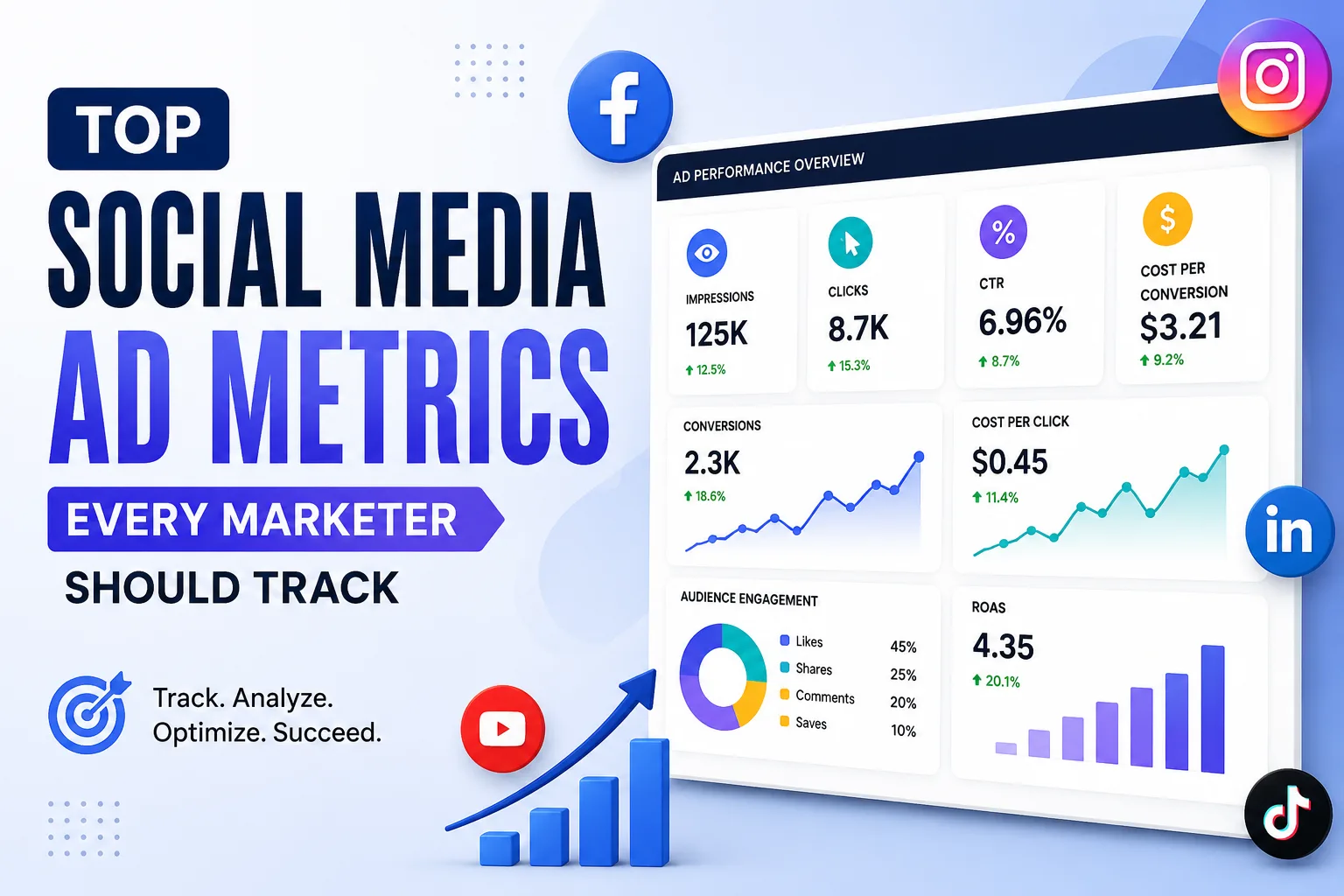
Running paid campaigns is only half the battle. The real success of any advertising campaign depends on how well you measure its performance. Tracking the right Social Media Ad Metrics helps marketers understand what’s working, identify areas for improvement, and maximize return on investment (ROI). Without accurate measurement, businesses risk spending money on campaigns that fail to deliver meaningful results.
Whether you’re managing campaigns on Facebook, Instagram, LinkedIn, TikTok, Pinterest, or X, understanding key performance indicators (KPIs) is essential for making data-driven decisions. This guide explains the most important social media advertising metrics every marketer should monitor and how they contribute to campaign success.
Why Social Media Ad Metrics Matter
Every advertising platform provides detailed campaign data, but not every metric deserves equal attention. Focusing on the right numbers enables businesses to optimize targeting, improve creative assets, reduce advertising costs, and increase conversions.
Monitoring Social media advertising metrics allows marketers to answer critical questions such as:
- Are the ads reaching the right audience?
- Which campaigns generate the highest engagement?
- Is the advertising budget being spent efficiently?
- Which creative performs best?
- Are campaigns generating profitable conversions?
Businesses that consistently analyze campaign data are better positioned to improve long-term marketing performance.
Social Media Ad Metrics You Should Monitor
Choosing the right metrics depends on your campaign objectives. However, several performance indicators are valuable for almost every advertising campaign.
1. Impressions
Impressions represent the total number of times your advertisement appears on users’ screens.
A high number of impressions indicates strong visibility, although it doesn’t necessarily mean users interacted with the ad.
Impressions help marketers evaluate brand exposure and campaign reach.
2. Reach
Reach measures the number of unique users who viewed your advertisement.
Unlike impressions, reach counts each person only once, making it useful for understanding audience size.
Comparing impressions with reach helps determine how frequently users are seeing your ads.
3. Click-Through Rate (CTR)
CTR measures the percentage of users who click your advertisement after viewing it.
A higher CTR generally indicates that your headline, creative, and call-to-action resonate with your target audience.
Improving CTR often leads to better campaign efficiency and lower advertising costs.
4. Cost Per Click (CPC)
CPC represents the amount you pay each time someone clicks your advertisement.
Lower CPC values usually indicate better audience targeting and more relevant creative content.
Monitoring CPC helps businesses manage advertising budgets effectively.
5. Conversion Rate
Conversion rate measures the percentage of users who complete a desired action after clicking your advertisement.
Conversions may include:
- Purchases
- Newsletter signups
- Contact form submissions
- App downloads
- Consultation bookings
High conversion rates indicate that both your advertisement and landing page are performing effectively.
6. Cost Per Acquisition (CPA)
CPA measures how much it costs to acquire one customer or lead.
Reducing CPA while maintaining quality leads is a primary objective for most marketers because it improves overall profitability.
7. Return on Ad Spend (ROAS)
ROAS measures the revenue generated for every advertising dollar spent.
For example, if you spend $100 on advertising and generate $500 in revenue, your ROAS is 5:1.
ROAS is one of the most valuable Key social media ad metrics because it directly measures campaign profitability.
8. Engagement Rate
Engagement includes likes, comments, shares, saves, video views, and other user interactions.
High engagement often indicates that your content is relevant, valuable, and interesting to your audience.
Strong engagement can also improve organic visibility on many social platforms.
9. Video View Rate
For video campaigns, measuring how many users watch your content is extremely important.
Platforms often report:
- 3-second views
- 10-second views
- Completed views
- Average watch time
These insights help marketers optimize video length and messaging.
10. Frequency
Frequency measures how many times the average user sees your advertisement.
Excessively high frequency may lead to ad fatigue, causing engagement and conversions to decline.
Monitoring frequency helps maintain campaign effectiveness over time.
How to Measure Social Media Ads Effectively
Understanding How to measure social media ads involves more than checking numbers inside your advertising dashboard.
Successful measurement begins by defining clear campaign objectives before launching advertisements.
Businesses should evaluate:
- Campaign objective
- Audience quality
- Landing page performance
- Conversion tracking
- Customer behavior
- Attribution reports
Knowing How to measure social media ads allows marketers to optimize campaigns using meaningful insights instead of assumptions.
Match Metrics with Marketing Goals
Different objectives require different performance indicators.
For example:
- Brand awareness campaigns prioritize impressions and reach.
- Traffic campaigns focus on CTR and CPC.
- Lead generation campaigns emphasize CPA and conversion rate.
- Sales campaigns rely heavily on ROAS and revenue.
Selecting the appropriate Key social media ad metrics ensures campaign evaluations align with business objectives rather than vanity metrics.
Social Media Ads Performance: Why Continuous Optimization Matters
Monitoring Social media ads performance should never be a one-time activity.
Campaigns require continuous improvements through:
- Audience refinement
- Creative updates
- Budget adjustments
- Landing page optimization
- Bid strategy improvements
Regular optimization helps advertisers reduce costs while increasing conversions.
Analyzing Social media ads performance over time also reveals seasonal trends, audience preferences, and opportunities for future growth.
Explore More : SEO Freelancer in Valpoi | SEO Freelancer in Panaji | SEO Freelancer in Hailakandi
Social Media Marketing KPIs Every Business Should Track
While individual metrics provide valuable insights, marketers should also monitor broader business objectives through Social media marketing KPIs.
Important KPIs include:
- Customer acquisition cost
- Lead quality
- Conversion value
- Customer lifetime value
- Revenue growth
- Return on investment
Tracking these Social media marketing KPIs ensures advertising efforts contribute directly to overall business success rather than simply increasing engagement.
Common Mistakes When Measuring Ad Performance
Many advertisers focus on vanity metrics while overlooking indicators that truly affect profitability.
Common mistakes include:
- Measuring impressions without tracking conversions.
- Ignoring landing page performance.
- Ending campaigns before sufficient data is collected.
- Failing to install conversion tracking.
- Optimizing based only on clicks instead of revenue.
Avoiding these mistakes leads to smarter decisions and stronger long-term campaign results.
Best Practices for Tracking Social Media Ad Metrics
To maximize campaign performance, marketers should follow proven measurement practices:
- Define campaign goals before launching advertisements.
- Install tracking pixels and conversion events correctly.
- Monitor reports regularly instead of waiting until campaigns end.
- Perform A/B testing on creatives, audiences, and calls-to-action.
- Use analytics insights to refine future campaigns continuously.
Consistent measurement and optimization create more efficient advertising strategies and better business outcomes.
The Future of Social Media Analytics
Artificial intelligence and machine learning are transforming campaign measurement.
Modern advertising platforms automatically analyze customer behavior, predict conversion opportunities, optimize bidding strategies, and recommend improvements using real-time data.
Businesses that embrace advanced analytics will gain a stronger competitive advantage while improving advertising efficiency.
Many organizations also work with experienced digital marketing agencies like DigitalParm to build performance-focused campaigns supported by accurate reporting and continuous optimization.
Conclusion
Tracking the right Social Media Ad Metrics is essential for improving campaign performance and maximizing advertising returns. Rather than focusing on vanity metrics alone, marketers should prioritize indicators such as CTR, conversion rate, CPA, ROAS, engagement, and audience reach to make informed decisions. By continuously analyzing data, testing new strategies, and refining campaigns, businesses can create more effective advertising efforts that support sustainable growth and long-term marketing success.
Frequently Asked Questions
1. What are Social Media Ad Metrics?
They are measurable data points used to evaluate the effectiveness and performance of paid social media campaigns.
2. Which metric is most important for social media advertising?
It depends on your objective, but ROAS, conversion rate, CTR, and CPA are among the most valuable metrics.
3. Why is CTR important?
CTR measures how many users click your ad, helping evaluate the effectiveness of your creative and messaging.
4. How often should I review ad performance?
It’s best to monitor campaign performance regularly, especially during active campaigns, to identify optimization opportunities.
5. What tools help measure social media advertising performance?
Platforms like Meta Ads Manager, LinkedIn Campaign Manager, TikTok Ads Manager, Pinterest Ads, Google Analytics, and conversion tracking tools provide detailed performance insights.


