


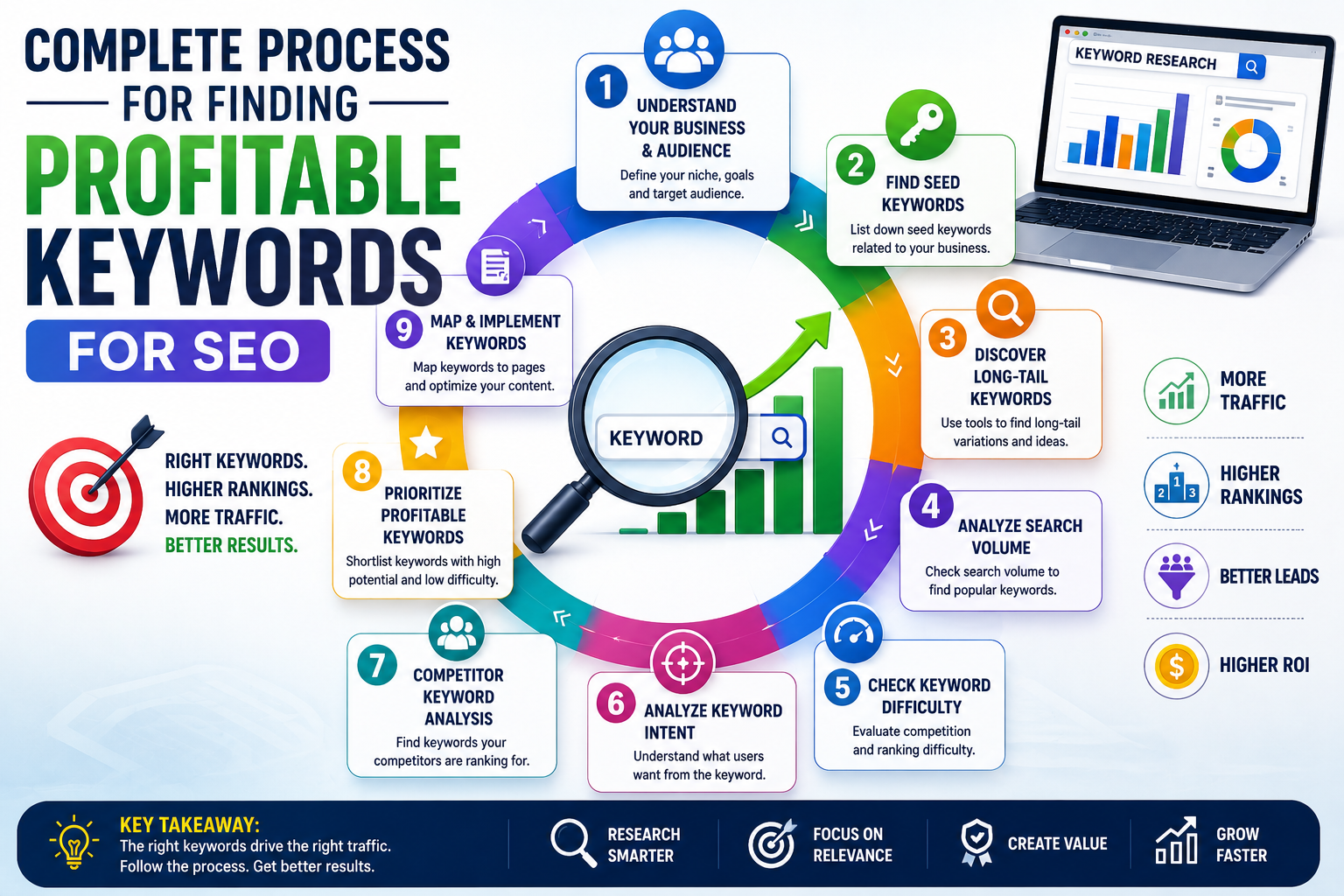
If you want your website to rank higher on Google, attract more visitors, and generate more sales, you need to start with Keyword Research for SEO.
Keyword research helps you understand what your target audience is searching for online. By targeting the right keywords, you can create content that brings valuable traffic to your website and improves your search engine rankings.
In this guide, you’ll learn the complete process of finding profitable keywords for your SEO strategy.
What is Keyword Research for SEO?
Keyword Research for SEO is the process of finding and analyzing the words and phrases people use in search engines when looking for information, products, or services.
The goal is to identify keywords that have good search demand and a realistic chance of ranking in search results.
Effective keyword research helps businesses:
- Increase website traffic
- Reach the right audience
- Create better content
- Improve search rankings
- Generate more leads and sales
Why Keyword Research is Important
Without keyword research, you may create content that nobody searches for.
Keyword research helps you:
Understand User Intent
You can learn what people want and create content that answers their questions.
Find Content Opportunities
Keyword research reveals topics your audience is interested in.
Improve SEO Results
Targeting the right keywords helps search engines understand your content.
Increase Organic Traffic
Ranking for relevant keywords can bring consistent visitors to your website.
Step 1: Understand Your Business and Audience
Before using keyword tools, think about:
- What products or services do you offer?
- Who are your ideal customers?
- What problems do they need to solve?
- What words might they use when searching online?
Create a list of topics related to your business.
Example:
If you run a digital marketing agency, your topics might include:
- SEO services
- Content marketing
- Social media marketing
- Website optimization
- Google rankings
These topics become the foundation of your keyword research.
Step 2: Create a List of Seed Keywords
Seed keywords are basic terms related to your business.
Examples:
- SEO
- Digital marketing
- Fitness training
- Online courses
- Web design
These keywords help you discover hundreds of related keyword ideas.
Step 3: Find Long-Tail Keywords
Long-tail keywords are longer and more specific search phrases.
Examples:
- Best SEO tools for small businesses
- Affordable digital marketing services
- How to improve website rankings
- Local SEO strategies for restaurants
Long-tail keywords are valuable because:
- They have lower competition
- They attract targeted visitors
- They often have higher conversion rates
Many SEO beginners focus only on short keywords and miss profitable opportunities.
Step 4: Analyze Search Volume
Search volume shows how many times a keyword is searched each month.
A keyword with high search volume can bring more traffic, but it may also be more competitive.
For example:
| Keyword | Monthly Search Volume |
|---|---|
| SEO | High |
| SEO for small businesses | Medium |
| Local SEO tips for restaurants | Low |
A balanced SEO strategy includes keywords with different search volume levels.
Step 5: Check Keyword Difficulty
Keyword difficulty measures how hard it is to rank for a keyword.
Factors affecting keyword difficulty include:
- Number of competitors
- Authority of ranking websites
- Quality of existing content
- Backlink profiles
For new websites, targeting low-competition keywords is usually the best approach.
Example
Instead of targeting:
“SEO”
Target:
“Keyword research for SEO beginners”
The second keyword is more specific and easier to rank for.
Step 6: Perform Competitor Keyword Analysis
Competitor keyword analysis helps you discover keywords that are already driving traffic to competing websites.
Study:
- Their blog topics
- Ranking keywords
- Content structure
- Featured snippets
- Frequently asked questions
Ask yourself:
- Which keywords are bringing them traffic?
- Which topics are they missing?
- How can you create better content?
Learning from competitors can save time and uncover valuable opportunities.
Step 7: Group Keywords by Topic
After collecting keywords, organize them into related groups.
Example: SEO Topic Cluster
Main Keyword:
- Keyword Research for SEO
Supporting Keywords:
- Long-tail keywords
- Keyword difficulty
- Search volume
- Competitor keyword analysis
- SEO content planning
This structure helps search engines understand your content and improves topical authority.
Step 8: Use Keywords for SEO Content Planning
The next step is SEO content planning.
Create content based on your keyword research findings.
Content Ideas
Informational Content
- What is SEO?
- How keyword research works
- SEO tips for beginners
Commercial Content
- Best SEO tools
- SEO services comparison
- SEO pricing guide
Transactional Content
- Buy SEO software
- Hire SEO consultant
- Local SEO services
A well-planned content strategy helps attract visitors at every stage of the customer journey.
Step 9: Prioritize Profitable Keywords
Not every keyword is worth targeting.
Focus on keywords that:
- Match your business goals
- Have reasonable competition
- Show buying intent
- Support lead generation
- Fit your content strategy
Profitability matters more than traffic alone.
For example, a keyword with 500 monthly searches and high purchase intent can be more valuable than a keyword with 10,000 searches and low conversion potential.
Common Keyword Research Mistakes
Avoid these common mistakes:
Targeting Only High-Volume Keywords
High-volume keywords are often difficult to rank for.
Ignoring Search Intent
Make sure your content matches what users want.
Skipping Competitor Research
Competitor insights can reveal profitable opportunities.
Keyword Stuffing
Use keywords naturally throughout your content.
Not Updating Keyword Research
Search trends change over time, so review your keyword strategy regularly.
Best Tools for Keyword Research
Popular keyword research tools include:
- Google Keyword Planner
- Ahrefs
- SEMrush
- Ubersuggest
- Moz Keyword Explorer
- Google Search Console
These tools help analyze search volume, keyword difficulty, and competitor data.
Conclusion
Keyword Research for SEO is the foundation of every successful SEO strategy. It helps businesses understand what customers are searching for and create content that attracts the right audience.
By focusing on long-tail keywords, analyzing search volume, checking keyword difficulty, conducting competitor keyword analysis, and improving SEO content planning, you can discover profitable keywords that drive traffic, leads, and sales.
The better your keyword research process, the stronger your SEO results will be.
Frequently Asked Questions (FAQs)
1. What is Keyword Research for SEO?
Keyword research is the process of finding and analyzing search terms that people use in search engines to discover relevant content, products, or services.
2. Why is keyword research important for SEO?
Keyword research helps businesses understand user search behavior and create content that attracts targeted organic traffic.
3. What are long-tail keywords?
Long-tail keywords are longer and more specific search phrases that usually have lower competition and higher conversion rates.
4. What is keyword difficulty?
Keyword difficulty is a metric that estimates how hard it will be to rank for a specific keyword in search engine results.
5. What does search volume mean?
Search volume refers to the average number of times a keyword is searched during a specific period, usually per month.
6. What is competitor keyword analysis?
Competitor keyword analysis involves studying the keywords that competing websites rank for to identify new SEO opportunities.
7. How does SEO content planning help?
SEO content planning ensures that content is created around targeted keywords and user intent, improving rankings and traffic.
8. How often should keyword research be updated?
It is recommended to review and update keyword research every few months because search trends and competition change over time.


